

Small Business Tax Secrets Revealed: What DIY Software Companies Don't Want You to Know
- smithtaxesandmore
- Dec 11, 2025
- 5 min read
Here's the uncomfortable truth: DIY tax software companies make money by keeping things simple. The simpler their interface, the more users they attract. But this convenience comes at a cost: your cost. While these platforms excel at basic tax filing, they often miss the sophisticated strategies that could save your small business thousands of dollars.
After working with hundreds of small business owners, I've seen the same pattern repeatedly. Business owners use popular DIY software, feel confident they've "done their taxes," then discover months later they left significant money on the table. Let's pull back the curtain on what you're really missing.
The 100% Bonus Depreciation Game-Changer

Most DIY software will mention depreciation, but they won't explain the massive opportunity that just became available. Starting January 19, 2025, 100% bonus depreciation is back: and it's now permanent unless Congress changes it.
Here's what this means: If you buy a $50,000 piece of equipment for your business, you can deduct the entire amount in the first year instead of spreading it over five or seven years. That's an immediate $12,500 tax savings if you're in the 25% bracket.
DIY software might calculate this correctly, but it won't strategically advise you on timing purchases to maximize this benefit. A professional tax planner, however, would recommend making major equipment purchases before year-end to capture the full deduction.
The QBI Deduction Most Software Underutilizes
The Qualified Business Income (QBI) deduction allows eligible small business owners to deduct up to 20% of their business income. On $100,000 in business profit, that's a $20,000 deduction: potentially saving $5,000 in taxes.
DIY software will calculate this deduction, but here's where they fall short: they won't help you structure your business operations to maximize QBI eligibility. They won't explain how salary elections in S-Corps affect the deduction, or how certain business expenses can be reclassified to increase your QBI.
Starting in 2026, new rules expand QBI eligibility for higher earners. Professional tax planners are already positioning their clients to take advantage of these changes. DIY software? They'll catch up eventually.
Home Office Deductions: Beyond the Basics

DIY software typically offers the simplified home office deduction: $5 per square foot up to 300 square feet ($1,500 maximum). It's easy to calculate and requires minimal documentation.
But what they don't tell you is that the actual expense method often provides much larger deductions. If you use 20% of your home for business, you can deduct 20% of your mortgage interest, property taxes, utilities, insurance, repairs, and depreciation.
For a home worth $300,000 with typical expenses, this could easily exceed $5,000 annually: more than three times the simplified deduction. The catch? It requires detailed record-keeping and professional calculation of depreciation schedules, something DIY software struggles to handle comprehensively.
The Retirement Contribution Strategy
Small business owners can contribute up to $70,000 to SEP-IRAs or Solo 401(k)s in 2025, plus another $7,000 to traditional IRAs. That's $77,000 in potential tax deductions.
DIY software will ask if you made retirement contributions and deduct the amount you enter. What they won't do is explain the difference between contribution types, optimal timing strategies, or how to structure multiple retirement accounts for maximum benefit.
They certainly won't recommend making last-minute contributions in early 2026 for the 2025 tax year: a strategy that could save thousands while giving you months of additional cash flow.
Vehicle Deductions: The Method Matters

DIY software typically defaults to the standard mileage rate (67 cents per mile for 2025) because it's simpler. For many small business owners, this leaves money on the table.
If you use a vehicle exclusively for business, the actual expense method often provides larger deductions. This includes 100% of gas, maintenance, repairs, insurance, registration, lease payments, and depreciation.
Professional tax planners analyze both methods annually and recommend the more beneficial approach. They also understand the documentation requirements and can help you maintain proper records to support your deductions.
Research and Experimental Expenses: The Hidden Opportunity
Here's a deduction most small business owners don't even know exists. Starting in 2025, businesses can fully deduct domestic research and experimental expenses, with retroactive relief available back to 2021.
This isn't just for tech companies. If your business develops new products, improves processes, or creates software solutions, you might qualify. DIY software rarely identifies these opportunities because they require industry knowledge and professional interpretation of tax code.
Employee Benefits: More Than Just Salaries

Employee salaries are obviously deductible, but DIY software often misses the full scope of employee benefit deductions. Health insurance premiums, retirement plan contributions, education and training costs, and even company vehicles can all be deductible business expenses.
Self-employed business owners can deduct health insurance premiums with no limit on the amount. If you provide employee benefits, you might qualify for tax credits like the Small Business Health Care Tax Credit: credits that DIY software rarely identifies or optimizes.
The Section 179 Equipment Advantage
The Section 179 deduction allows businesses to deduct up to $2.5 million in equipment purchases for 2025. Combined with bonus depreciation, this creates powerful tax planning opportunities.
DIY software will apply these deductions mechanically, but they won't help you plan equipment purchases strategically. Should you buy that computer system in December 2025 or January 2026? The timing could affect your tax liability for multiple years.
Why DIY Software Falls Short
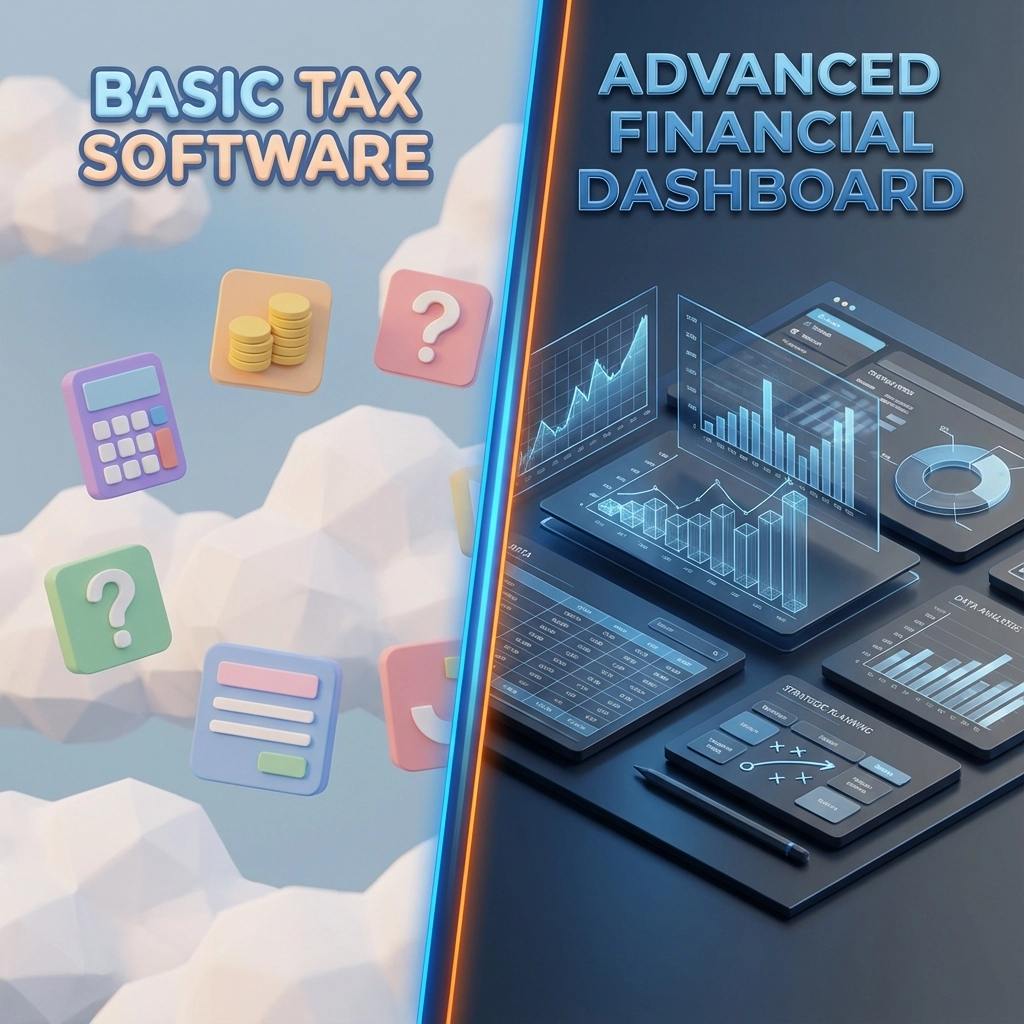
DIY software companies design their platforms for the masses. They optimize for ease of use and broad applicability, not maximum tax savings for small businesses. Their business model depends on processing millions of simple returns efficiently.
Complex strategies require human expertise, ongoing education about tax law changes, and personalized analysis of each business situation. These capabilities don't scale to software platforms serving millions of users.
Moreover, DIY software can't provide the year-round tax planning that maximizes deductions. They're reactive tools for tax filing, not proactive strategies for tax optimization.
The Professional Advantage
Professional tax planners stay current with tax law changes, understand industry-specific deductions, and can structure business operations for maximum tax efficiency. They think strategically about multi-year tax planning and can identify opportunities that software simply can't recognize.
More importantly, professionals provide ongoing guidance throughout the year. They help with quarterly estimates, advise on major business decisions, and ensure you're positioned to take advantage of every available deduction.
Making the Right Choice for Your Business
The question isn't whether DIY software can file your taxes: it can. The question is whether you want to file basic taxes or optimize your tax strategy for maximum savings.
For simple businesses with straightforward income and few deductions, DIY software might be adequate. But if you're serious about minimizing your tax liability and maximizing your business profits, the sophisticated strategies we've discussed require professional expertise.
The "secrets" aren't really secrets: they're legitimate tax strategies that require knowledge, experience, and ongoing attention to detail. DIY software companies don't hide this information maliciously; they simply can't provide the personalized, strategic guidance that complex tax optimization requires.
Your business deserves more than basic tax filing. It deserves a tax strategy designed to keep more money in your pocket where it belongs.
Comments